


ON THIS PAGE
-
electronica China 2027: Analog Tech's Shift from Support to Definition
Press Release
electronica China 2027: Analog Tech's Shift from Support to Definition
Nov 19, 2026
electronica China 2027 will be held from April 14 to 16 at Shanghai New International Expo Centre (SNIEC). In the upstream core chip cluster of the exhibition, analog devices—especially for power management and signal chains—occupy a densely concentrated area of booths. This is no longer just a place for “device selection”, but is becoming a cutting-edge window for observing how the underlying architecture of electronic systems is being redefined. Taking “from chip performance to system integration” as its core theme, the exhibition has set up a dedicated analog device zone.
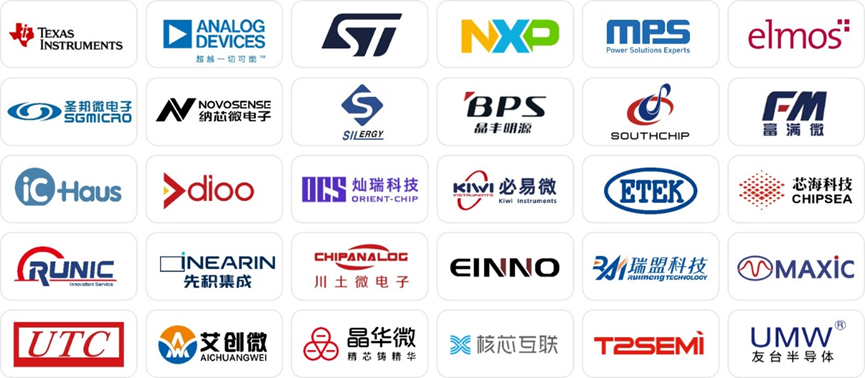
Analog IC exhibitors (*in no particular order)
Trend assessment: Four accelerating structural shifts
AI computing power is turning power management into an architectural issue
The 54 V DC architecture has simultaneously hit the ceiling in copper loss, space and number of conversion stages, and migration to 800 V DC has become a prerequisite for supporting the next generation of computing power. Rack power is climbing from tens of kilowatts to the megawatt level, and the value contribution of analog devices within a single rack is jumping accordingly. Direct conversion from 800 V to low voltage requires fewer conversion stages, higher isolation voltage ratings, more accurate current sensing and multiphase control. The roadmap of analog devices is being reverse-shaped by downstream computing platforms.
The value logic of automotive analog devices has changed
The continuous rise in per-vehicle device count is only the surface; at a deeper level, the electrical/electronic architecture is converging from distributed ECUs to domain controllers, and analog devices are shifting from “scattered deployment” to “high-density, high-safety integration at the domain-control level.” Power management and signal chains benefit simultaneously, but the competitive barrier is shifting from “passing automotive-grade certification” to “being designed into the whole-vehicle system at the architecture definition stage.”
The structural gap in industrial high-precision signal chains
The localization rate of general-purpose analog devices is already high, but high-precision ADC/DACs, digital isolators and isolated power supplies remain weak points. The real threshold in industrial scenarios is not “being able to make it”, but ensuring that accuracy does not drift under wide temperature ranges, strong interference and long lifecycles. Competition in signal chains is shifting from individual products to full-link capability across “sensor interface—conditioning—conversion—isolation—power”.
The technological paradigm is shifting from “designing chips” to “delivering package-level systems”
Wide bandgap materials are entering large-scale deployment, but realizing their value depends on matching drive, isolation and control; chiplets and heterogeneous integration allow analog circuits using different processes to coexist within a single package, making the package itself part of the architecture; embedded AI engines are sinking into the analog front end, turning devices from “functional blocks” into “intelligent interfaces to the physical world”.
Exhibitor updates
TI, NXP, ST and ADI are focusing on high-precision signal chains and 800 V power architectures; domestic manufacturers such as Novosense, SG Micro, Silergy and Southchip are accelerating platform-based expansion in areas such as AI server power supplies and automotive-grade PMICs.
Analog technology is shifting from being the system’s “underlying support” to “architecture definition”. Whoever can deliver practical, deployable system logic on top of the chip will hold foundational discourse power in the next round of electronic system evolution.
The real highlight of the analog device zone is not the record-breaking specs of any single chip, but a shift that is underway: analog technology is moving from being the system’s “underlying support” to “architecture definition”. As power-supply architectures, signal-chain integrity and scenario-based system capabilities become the main battlefield of competition, whoever can deliver practical, deployable system logic on top of the chip will hold foundational discourse power in the next round of electronic system evolution. From April 14 to 16, 2027, at electronica China in the Shanghai New International Expo Centre (SNIEC), the answer will begin to unfold.
Exhibitor application for electronica China
Claim your share of success—with an exhibition stand in the right location at electronica China.

